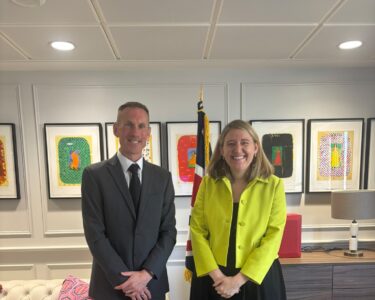
We are delighted to announce that Torpoint Community College has successfully secured its second Quality Mark, recognising the school’s sustained commitment to high‑quality, research‑informed Holocaust education.
Torpoint Community College first became a Beacon School in 2016–17, achieving its initial Quality Mark in 2018 and re‑accrediting in 2022. This latest reaccreditation comes at a moment of renewal for the school: following a period of staffing transition, the programme is being re‑established with care, integrity and a clear sense of purpose. The review found that Holocaust education at Torpoint is now entering a new phase of consolidation and growth, with strong foundations in place for the years ahead.
A rigorous, coherent and humanising curriculum: The review highlighted the strength of Torpoint’s Year 9 Holocaust scheme, which sits within a carefully sequenced KS3 curriculum. Students arrive at the unit with secure disciplinary foundations, enabling them to engage with the Holocaust as a historically specific process rather than a moral parable. The 18‑lesson sequence moves from pre‑war Jewish life through escalation, persecution, genocide, resistance and aftermath, foregrounding complexity, human stories and the habits of historical enquiry.
The curriculum makes powerful use of personal narratives, including the Federmann and Greenman families, and integrates local history through the ‘Cornish Stories of Survival’ work. This approach gives the scheme a strong sense of place and relevance, helping students understand that the legacies of the Holocaust reach into every community. As one student explained during the panel: ‘It made it feel real… like this history isn’t far away, it’s connected to people and places we know.’
High‑quality teaching rooted in enquiry and care: The lesson observation provided compelling evidence of thoughtful, research‑informed practice. Mr Justin Miller’s teaching was calm, rigorous and intellectually ambitious, with students supported to think, speak and behave as historians. The observed enquiry, ‘What does Bernhard’s story reveal about life under Nazi rule?’ enabled students to interrogate multiple sources, test hypotheses and refine interpretations with increasing sophistication.
Torpoint students spoke with clarity about their learning. They described lessons as ‘immersive,’ ‘safe,’ and ‘a space where we really think.’ One student commented: ‘We don’t just learn what happened, we learn how to understand it properly.’ Their ability to articulate disciplinary concepts such as inference, reliability and bias is a testament to the quality of teaching they receive.
A distinctive contribution from the Art department: The review also recognised the exceptional contribution of the Art department. Under the leadership of Mrs Debra Jones, students engage in portrait work inspired by Holocaust survivors, using charcoal, greyscale and contrast to explore emotion, dignity and human presence. Students often refer to the individuals they draw by name, a powerful indicator of emotional connection and ethical engagement. This cross‑curricular work enriches the historical study and exemplifies the school’s commitment to humanising the past.
Student voice reveals impact and relevance: The student panel was a particular strength of the review. Pupils spoke with maturity, empathy and insight about their learning, demonstrating both secure knowledge and deep emotional literacy. Their reflections were candid, thoughtful and grounded in genuine engagement with the material. The review noted that Torpoint students ‘think historically, feel responsibly and speak with dignity.’
Leadership, transition and a renewed sense of direction: The reaccreditation comes after a period of staffing change, during which responsibility for the programme passed to Mr Justin Miller. The review found that Mr Miller has led the scheme with integrity, reflection and an emergent specialism, refining the curriculum to balance rigour, enquiry and cognitive load. His leadership has provided stability and direction at a crucial moment, and it is clear he regards reaccreditation as serving as a springboard for further development. He reflected:
“Preparing for the reaccreditation process gave us a valuable opportunity to reflect carefully on the work we do at TCC and the importance of Holocaust education within the wider life of the College. The process itself felt genuinely collegial and collaborative – rigorous, certainly, but also supportive and reciprocal. One of the most rewarding aspects of the day was seeing our student panel engage so thoughtfully and confidently with the UCL assessors. Their maturity, insight and compassion were a powerful reminder of why this work matters so much. Being reaccredited as a Beacon School is something we are incredibly proud of, and we look forward to continuing to develop this work in partnership with UCL over the coming years.
We are grateful too, to Mrs Cheryl Lockett in her role as SLT link, and to Mr Rod Truan, Mr Kit Richardson, for their time, insights during the review process and for their commitment to deepening, over time, the College’s Beacon School, and for the longstanding support of Headteacher Dr Jeremy Plumb, who said:
“Achieving our second reaccreditation as a UCL Beacon School is a powerful endorsement of the values that underpin Torpoint Community College. Holocaust education sits at the heart of our commitment to inspiring optimistic learners, young people who think critically, act with compassion and engage confidently with the world around them. This reaccreditation reflects not only the strength of our provision, but also the dedication of colleagues who lead this work with such integrity, and the maturity shown by our students throughout the process. We are proud to continue our partnership with UCL as we deepen and extend this vital strand of our curriculum.
The Centre’s Nic Wetherall MBE, who led the review, reflected:
“Returning to Torpoint has been a reminder of how powerful Holocaust education can be when it is held with care and humility. The conversations with Mr Miller and colleagues revealed a team navigating transition, honouring both the legacy they inherited and the families whose stories they now steward. The ‘Cornish Stories of Survival’ and the Federmann narrative were handled with such dignity, and the lesson observed bore hallmarks of quality teaching and learning about the Holocaust that lingered long after the review ended. Above all, it was the students who formed the moral and evidential heart of this reaccreditation: their empathy, clarity and ethical seriousness spoke more eloquently than anything else about the impact of this work. It has been a privilege to witness the emergent specialism, steadiness and integrity with which Mr Miller is guiding Torpoint’s Beacon identity forward, and I look ahead to supporting him as he shapes the College’s next chapter.
* *The full Torpoint Community College 2026 report, featuring extensive details of their strengths and identification of suggested developmental action points, will be available soon.
The UCL Quality Mark scheme is a great way to celebrate and share best practice and is both developmental and forward looking. Read more about undertaking the Quality mark process or contact Nic Wetherall to discuss.