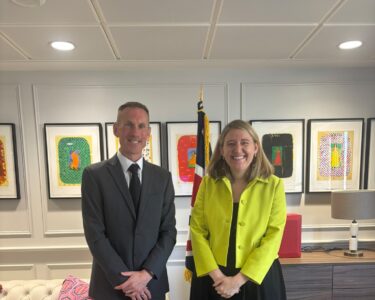
The UCL Centre for Holocaust Education is delighted to announce its latest Quality Mark Beacon School: Hestia School in Brigg. This award recognises the school’s exceptional, research‑informed and deeply human approach to Holocaust education, a model that stands out not only within the SEND/SEMH sector, but in its own right as high‑quality provision.
One student captured the heart of Hestia’s work with striking simplicity:
‘You help us understand the people, not just the events.’
This clarity, the instinct to look beyond chronology to human experience, reflects the culture Hestia has built: relational, reflective and grounded in trust.
A school where values, pedagogy and culture align: From the outset, the review revealed a school where Holocaust education is anchored in strong values, careful pedagogy and a culture of emotional safety. Staff at all levels, notably Headteacher Mrs Michelle Huckle, SLT lead Mr Gary Barker, and Lead Teacher Mr Rob Horton, demonstrated a rare blend of professional rigour and human‑centred practice. Their work is grounded in research, shaped by reflective practice and animated by a commitment to ensuring that every student encounters this history with dignity, curiosity and care.
A curriculum that balances ambition with accessibility: Hestia’s 15‑lesson Year 9 scheme is a carefully sequenced, research‑informed curriculum shaped by sustained engagement with UCL CPD, the Berlin study visit and high‑quality training. It moves students from pre‑war Jewish life and historic antisemitism through escalation, the Holocaust by bullets, camps and killing centres, resistance, responsibility and post‑war justice.
The scheme is deliberately flexible, allowing teachers to adapt pace, scaffolding and emotional support to the varied needs of SEND learners. Slow‑reveal enquiry, artefact work, personal stories and myth‑busting are used with care and purpose. The observed lesson on antisemitic propaganda exemplified this approach: students analysed visual sources, used disciplinary vocabulary confidently, and made thoughtful links between past and present.
Teaching that is relational, rigorous and emotionally attuned: Teaching at Hestia is characterised by strong relationships, careful scaffolding and a deep understanding of emotional regulation. Staff skilfully balance cognitive challenge with duty of care, creating a climate where students feel safe to ask questions, take risks and think critically.
The review highlighted the influence of UCL research on staff practice, from sequencing and enquiry design to the ethical use of images and the importance of tackling misconceptions. Gary’s reflections on the Berlin study visit, and Rob’s openness about how his dyslexia shapes his modelling and pacing, were powerful reminders of how professional identity and pedagogy intertwine. A particularly striking moment came when students examined Goebbels’ Ministry of Propaganda and Public Enlightenment. One student paused, looked again, and observed: ‘It’s strange they called it ‘enlightenment’… it was the opposite.’ This kind of insight, precise, critical, ethically alert, speaks to the curiosity, insight and seriousness Hestia nurtures.
Students as the moral centre of the review: The student panel was a highlight of the review. Their candour, empathy and insight, particularly their reflections on propaganda, responsibility and the human stories they had encountered, demonstrated the depth of their learning and the strength of the school’s relational culture. Their voices were the moral and evidential centre of the review.
Leadership that creates the conditions for excellence: Hestia’s achievement is rooted in strong, values‑driven leadership. Michelle, Gary and Rob have created a culture where difficult history is taught with integrity, sensitivity and ambition. Their commitment to relational pedagogy, emotional safety and research‑informed practice was evident throughout.
Upon achieving the Quality Mark Headteacher Michelle Huckle said:
‘The school community takes great pride in attaining the Quality Mark for Holocaust education. As a Special Educational Needs and Disabilities (SEND) institution where inclusion is a foundational principle, we aim to demonstrate to the wider educational community that the Holocaust can be effectively taught to all students, regardless of their individual disabilities.
The dedicated efforts of Gary and Rob in securing this Quality Mark have established a robust framework that ensures our students will continue to receive this vital education for years to come. Furthermore, it has been a privilege to collaborate with Nicola Wetherall, whose inspirational knowledge and support has been instrumental to our success.’
Gary Barker, originally the Beacon School Lead Teacher, now SLT Lead reflected:
‘Achieving the Holocaust Education Quality Mark as Lead Teacher has been the most amazing journey, both professionally and personally. The process encouraged deep reflection on purpose, pedagogy and impact, and reaffirmed my commitment to delivering Holocaust education that is ethical, thoughtful and meaningful for all learners. Becoming a Beacon School opened invaluable opportunities, from high-quality CPD to studying in Berlin, each of which continues to shape my classroom practice.
A visit to the Topography of Terror, where I encountered a single powerful image, led to the creation of a lesson exploring power, complicity and responsibility. That lesson was later shared more widely and received encouraging feedback from other educators. The Beacon School journey has also allowed me to contribute to national conversations around Holocaust education, including being interviewed about assessment for a CPD course and taking part in a podcast with Robert Rinder.
This academic year has been particularly meaningful, as I’ve supported a non-specialist teacher to deliver the course. Through regular professional conversations, collaboration and reflection, I’ve seen firsthand how the Quality Mark framework supports confidence, consistency and excellence across a school. As I move into a more senior leadership role, my goal is to embed this quality of Holocaust education sustainably, ensuring it remains a collective responsibility and a lasting strength of our curriculum.’
Having taken up the baton of Beacon School Lead Teacher, Rob Horton said:
‘The quality Mark process was a positive challenge and a pleasure to be a part of. It provided me with a further impetus to reflect not only upon the development of my subject knowledge but also the diverse nature of Holocaust learning.
This in turn provided me with the opportunity to create and develop pupil-based learning opportunities that my students found both challenging and rewarding. This was evident through their engagement in all topics as well as their curiosity and desire to offer their views during exploratory debates and discussions. Very often these would focus on psychology, ethics and social issues that are relevant today.
This combined with my increased learning, reflection and awareness of the issues surrounding the Holocaust very much created a student-centred learning climate. The impact of this upon the students is evident not only in their Humanities lessons but within other subjects that they study. They have grown in confidence to verbalise their views, develop their own learning targets and learner resilience.
As such the whole process has been empowering for my students and myself alike.’
The Centre’s Nic Wetherall MBE, who led the review, reflected:
‘It has been a genuine privilege to walk alongside you throughout this reaccreditation process. The open, reflective and deeply authentic conversations with Gary, Rob and Michelle revealed educators who lead with humanity first and professionalism second – passionate, values‑driven colleagues whose relational practice shapes everything they do. Meeting your students was equally inspiring; their insight, empathy and honesty spoke powerfully of the culture you have created together and truly enriched the review. What you offer is not simply strong Holocaust education within a SEND context, but high‑quality provision in its own right: thoughtful, ambitious and transformative. Your students, staff, families and wider community can be as proud of you as we are at the Centre; you are true ‘Beacons’, and we look forward to supporting the next steps of your journey.’
A significant achievement: Hestia’s Quality Mark award demonstrates that SEND learners can engage meaningfully with complexity when teaching is relational, scaffolded and grounded in research. It is a testament to the school’s integrity, ambition and care, and a powerful example of what Holocaust education can be when pedagogy, relationships and values align.
We congratulate the whole Hestia community on this significant achievement.
*The full Hestia School 2026 report, featuring extensive details of their strengths and identification of suggested developmental action points, will be available soon.
The UCL Quality Mark scheme is a great way to celebrate and share best practice and is both developmental and forward looking. Beacon School alumni considering undertaking the Quality mark process can read more on our website or contact n.wetherall@ucl.ac.uk.