(Waldsiedlung’ Woodland Community, Krumme Lanke. Constructed in the late 1930s as the ‘SS-Kameradschaftssiedlung’ SS Comradeship Settlement, Krumme Lanke. Image author’s own, January 2025)
As part of their Beacon School Programme 2025-6, our cohort of lead teachers attended their second residential at the end of May 2026 in Berlin, Germany. This important addition to our acclaimed Beacon School programme has been made possible through generous funding and support from the Association of Jewish Refugees (AJR) and Pears Foundation.
In visiting and exploring various sites across what was the capital city of the perpetrators of the Holocaust, the home of Germany’s largest Jewish community in 1933 and a space from where wider German society witnessed the persecution and eventual deportation of their Jewish neighbours, we aim to provide our lead teachers with the opportunity to secure deeper understandings about this important history amongst their students. The project utilises the learning that can take place through site visits and combines this with the Centre’s evidence-based model of continuing professional development. Through a research-informed approach which focuses on problematising assumptions and combatting misconceptions, the project seeks to engage teachers with the important themes of perpetration, complicity and responsibility in a distinctive and powerful way.
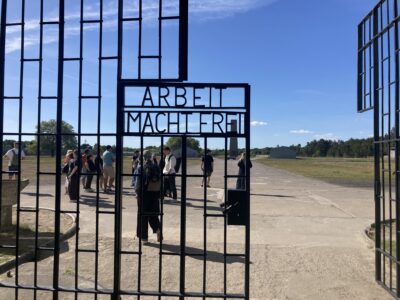
Across a four day visit, our lead teachers engaged with various sites, ranging from those that we readily associate with perpetrators of the Holocaust, such as the House of the Wannsee Conference, the former concentration camp of Sachsenhausen and the Topography of Terror to the far lesser known ‘Comradeship Settlement’ (see main image) nestled amongst the trees close to Krumme Lanke in the affluent southwestern Berlin suburb of Zehlendorf.
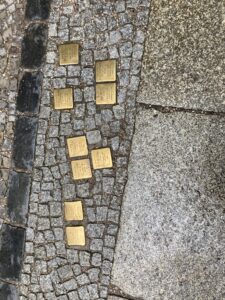
The group explored the central Berlin district of Mitte to find traces of Berlin’s pre-war Jewish community alongside the spaces that their absence has left. Amongst the many Stolpersteine (image below) in this part of the city, we encountered generations of families, remembered by small plaques placed in the sidewalks outside their last known residence. Small perhaps, but powerful reminders that form part of what has become the largest decentralised memorial in Europe.
Across the programme, our lead teachers benefited from the input and expertise of Centre colleagues, workshops from valued colleagues in Berlin including Wolf Kaiser, former Director of the Educational Department at Wannsee and excellent walking tours led by UCL’s Professor of German History, Mary Fulbrook. Access to such expertise afforded invaluable insights into the essential but deeply troubling and complex themes of Holocaust perpetration and wider societal complicity. On the ground logistical planning and support from the Centre for International Experiential Learning (CIEL) ensured that our teacher participants felt supported throughout and able to immerse themselves in the opportunities afforded to engage with this subject in a deep and impactful way.
Lead teachers will now be taking these experiences back to schools across the country, as part of their Beacon School journeys. Throughout the visit, teachers reflected upon the impact of the programme upon their own subject knowledge and expertise, how best to share these insights with their students, and how to embed all they had learnt into their teaching practice. Of the Alexander Haus, one teacher commented:
“Our visit to the Alexander Haus demonstrated how microhistory can illuminate the wider processes of exclusion, dispossession and persecution under National Socialism. The brilliant tour and seminar at the site reinforced the pedagogical value of integrating individual experiences with wider contextual analysis to develop a more nuanced understanding of the Holocaust.”
This observation captures much of the value of site visits in Holocaust pedagogy, and the value of exploring lesser-known sites such as the Alexander Haus and the Otto Weidt museum, which can re-humanise the stories of individuals experiencing and resisting Nazi persecution. The Alexander Haus, a summer house in the leafy, lake-suburbs near Potsdam, was a much-loved home to a German Jewish family whose lives and property became entangled with ‘Aryanisation’, Nazi persecution and forced emigration.
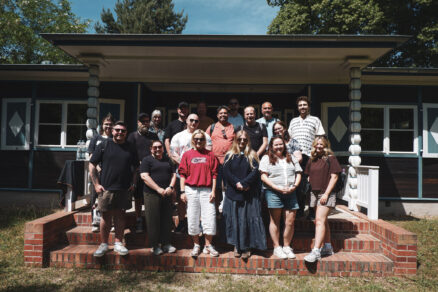
Colleagues at the Centre will continue to work with our cohort of Lead Teachers through the final stages of their Beacon School Programme 2025-6, supporting them as they develop their Holocaust schemes of learning. An invaluable addition to the overall Beacon School programme, the Berlin residential visit complements an already rigorous, ongoing and research informed CPD opportunity which enables teachers to secure the best outcomes for their students when teaching and learning about this complex and important history. We look forward to seeing its ongoing impact in our Beacon Schools.
Helen McCord (Berlin CPD Programme Lead, UCL) & Corey Soper (Beacon School Programme Lead, UCL)
Supported by: